The short answer. Only your policy wording and your insurer can tell you whether a temporary kitchen is part of your claim. Some insurers say they can provide one so that you can stay at home rather than move out, but it is not always possible. Ask early, get any agreement in writing, check the kitchen on the day it arrives, and keep your bills and receipts.
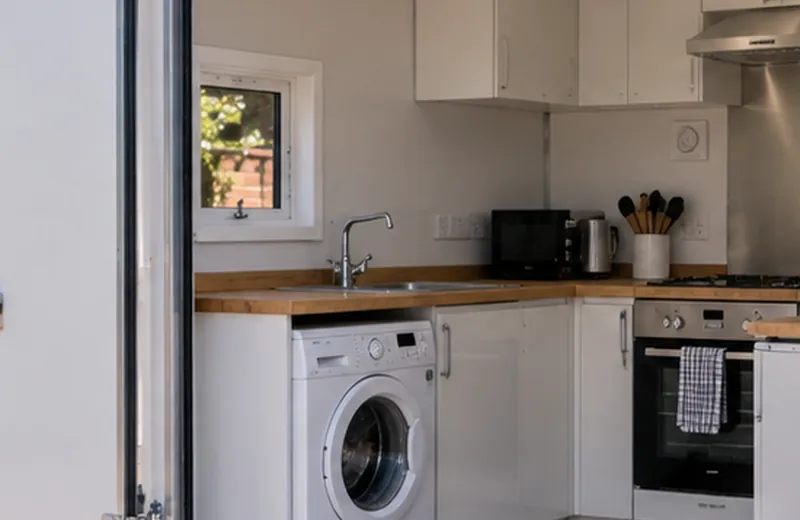
Compare Kitchen Hire is an independent directory of temporary kitchen suppliers. We are not an insurer, a broker or a claims adviser, and we have not seen your policy. This guide draws on the Financial Ombudsman Service's published guidance and decisions, the Financial Conduct Authority's claims rule and one insurer's help pages.
Each Ombudsman decision quoted here is one complaint, decided on its own facts, and the Ombudsman says its decisions are not a definitive statement of the law or of its approach. If your kitchen is out of use because of planned building work rather than damage, our guide to living without a kitchen during renovation is the better place to start.
Does home insurance cover a temporary kitchen?
It depends on your policy and your claim. Only your policy wording and your insurer can answer that, so ask them before anything is booked.
Policies differ, and we cannot tell you what yours includes. Some supplier websites say what policies usually cover. We leave those claims out, because only your insurer can confirm what applies to you.
One insurer, Ageas, says on its help pages that it "can provide facilities like temporary kitchens" so that customers can stay in their own homes where possible, and that alternative accommodation is "subject to the limits of your Buildings & Contents policy cover". That is Ageas describing its approach for its own customers, not any other insurer's.
Ageas also tells its customers to "refer to your policy documentation", which is good advice for anyone. Look in your policy booklet for any section on alternative accommodation and any limit attached to it. Then ask your insurer or loss adjuster whether it can provide a temporary kitchen so you can stay at home, and ask for the answer in writing.
Why might an insurer offer a temporary kitchen instead of a move?
A home without a kitchen may count as uninhabitable. A temporary kitchen can restore cooking facilities, so the household may stay at home.
The Ombudsman's guidance for insurers says that, when it looks at a complaint, it is likely to say a home is uninhabitable if, among other things, "there are no kitchen, bathroom or toilet facilities". In its words, alternative accommodation pays "the reasonable additional cost of temporarily rehousing" a household "when the home becomes uninhabitable because of the damage caused by something covered by the policy".
A temporary kitchen is one way of putting cooking facilities back. In decision DRN-2825594 (2021), after a kitchen leak, Lloyds Bank General Insurance gave a homeowner a kitchen pod instead of alternative accommodation and extended the hire several times. The ombudsman said a pod "can be a direct alternative" to alternative accommodation, and found the house habitable with it because it had the basic facilities.
Is a temporary kitchen always possible?
No. In one 2025 decision the insurer's loss adjuster considered a kitchen pod and found it unviable, so the homeowner needed alternative accommodation instead.
That was DRN-5680696 (Ageas, 2025), an escape of water claim. The decision does not say why the pod was unviable. The repairs would leave the home without any cooking facilities, so work could not start until the homeowner moved out, and finding a suitable property took many months.
A pod also needs space and connections at your property, and each supplier sets its own requirements: our kitchen pod hire comparison sets them side by side. Nor is a pod the only kind of temporary kitchen. In DRN-4110059 (Ageas, 2023) the family stayed at home and their conservatory was converted into a temporary kitchen.
What if a pod would not suit your household?
Tell your insurer before the pod arrives. The Ombudsman says having cooking and washing facilities does not by itself make a home suitable for everyone.
Its guidance for insurers says it will "always look at the customer's individual circumstances" when deciding whether a home is habitable or safe. Living with a pod also means cooking outside the house:
- In DRN-3649812 (Royal & Sun Alliance, 2022), the insurer offered alternative accommodation, but the couple wanted to stay at home and accepted a pod on their drive. They said they "had to cook outside in all weather conditions". The insurer discussed other accommodation with them more than once.
- In DRN-2825594 (Lloyds, 2021), the homeowner said he had to carry meals and drinks out of the back door and in through the front. The ombudsman noted that he had accepted the pod, and had not raised this until some time after it was installed.
So before you agree, think about health, mobility, young children, the weather and the route between the pod and where you will eat. If you have a concern, put it to your insurer in writing at the start, not weeks later.
Who arranges the temporary kitchen?
It can be your insurer, its loss adjuster or you. Before delivery, get written confirmation of who books it, who pays and for how long.
In the decisions we read, the insurer's side arranged the pod: Lloyds after a site meeting in DRN-2825594, Royal & Sun Alliance in DRN-3649812, and Advantage Insurance in DRN-5614087. If you would rather find a supplier yourself, ask your insurer first whether it will agree to that supplier and on what terms. Do not book on the assumption that you will be paid back.
How listed suppliers say they work with insurers
All six suppliers listed on Compare Kitchen Hire mention insurance or damage work on their websites. These are their own descriptions of how they work, checked on 28 October 2026. They are not statements about what any insurer will pay, and being listed here does not mean a supplier is approved by any insurer.
- Temporary Pod Solutions asks for your insurer and claim reference number, discusses the hire and pricing with your insurer or loss adjuster, agrees everything in writing and, where agreed, invoices your insurer directly. It says that if your insurer will not pay for the pod, you can still hire it at its usual prices.
- The Kitchen Rescue says it liaises directly with loss adjusters and can provide quotes, invoices and delivery confirmation for claim authorisation.
- Galleys says it can provide quotes prepared for insurers and invoice the insurer directly once the hire is approved.
- Northern Kitchen Pods says it can provide an itemised quote for you to submit to your insurer, and works with homeowners, loss adjusters and insurance companies.
- Kitchenpod (listed with us as Pod Solutions Group) says its temporary kitchens can be used during insurance claims after flood, fire or water damage, inside the home or outside.
- Essential Spaces lists insurance work among the jobs it does, without describing a process.
Coverage areas differ, so check who delivers to you in the full supplier directory.
What is the difference between a loss adjuster and a loss assessor?
A loss adjuster is appointed by your insurer to investigate the claim. A loss assessor is a firm you choose to act on your behalf.
In DRN-5680696, Ageas "instructed a loss adjuster to investigate" the damage. In DRN-5812852 (2025), after a fire, a family appointed a loss assessing firm, Oakleafe Group, "to act on their behalf to manage and settle the claim". They expected it to manage everything, including their alternative accommodation; the firm said its job was only to negotiate a settlement with the insurer. The ombudsman found its terms of business unclear and upheld the complaint. Before you sign with an assessor, ask in writing what it will and will not handle, including any temporary kitchen.
What is a disturbance allowance?
A payment towards reasonable extra costs of living through a claim, such as extra food, laundry and travel. Ask your insurer if one applies.
The Ombudsman's guidance for insurers describes it as compensation for "the reasonable extra costs a customer has incurred by choosing to remain in their home", or in the accommodation they have been moved to. Typical costs it lists are extra food, laundry, travel, rehousing pets and council tax. It says:
- the amount is usually the extra cost you can prove, with evidence such as receipts for your normal spending going back at least a month before the claim, and for your spending during it;
- without that evidence, it will usually say the industry standard rates of £10 a day for each adult and £5 a day for each child living at the home are reasonable, and it will not ask an insurer to change its own rate if that is in the region of these;
- if you say you spent more than the standard rate, you will need to produce evidence.
In DRN-5855603 (Intact Insurance, 2025), while the homeowner's oven and fridge freezer were not working, the insurer paid a disturbance allowance of £10 a day rather than alternative accommodation, and the ombudsman found that fair. In DRN-4110059, Ageas paid a disturbance allowance while the family lived at home with a temporary kitchen in the conservatory. Whether one is paid in your claim is for your insurer to decide, so ask, and keep receipts either way.
What should you check when the pod arrives?
Check that every appliance works and that you have what was agreed. Photograph where the pod stands, and report any problem in writing that day.
In DRN-5614087 (Advantage Insurance, 2025), the ombudsman noted the pod's oven did not work at first and a fridge was supplied instead of a fridge freezer. The insurer put things right very quickly once told. The pod had also been placed on the homeowner's lawn and damaged the grass, and the ombudsman agreed a payment towards soil and reseeding.
- Switch on each appliance that is fitted and check that it works.
- Compare what was delivered with what was agreed in writing.
- Photograph the ground under and around the pod on delivery and again on collection.
- Read your electricity meter.
- Report any problem to whoever arranged the pod by email the same day, and keep a copy.
What each listed pod includes is on our kitchen pod hire page.
Who pays for the extra electricity?
Ask before delivery. In one 2025 decision the insurer repaid the homeowner's higher electricity bills, but only after working out the actual cost.
A pod runs on your household electricity. In DRN-5614087 the insurer repaid the extra cost, but the homeowner was out of pocket while she waited, and the ombudsman did not think that wait unreasonable. So ask at the start who pays and how to claim it back, read your meter when the pod arrives and when it leaves, and keep your bills. If you are paying for the hire yourself, our guide to temporary kitchen hire costs covers who pays for gas and electricity with each supplier.
What happens if the repairs take longer than expected?
Repairs can take longer than estimated. Ask how extensions to the hire are agreed, and keep a dated record of any delays.
In DRN-3649812 the insurer first estimated two to three months. The work took about five, including about seven weeks of avoidable delay that the insurer accepted, and the ombudsman increased the compensation for it. The Ombudsman's guidance for insurers says it will consider compensation if repairs took longer than they should have. It also says that where a claim has simply taken longer than expected, without delays caused by the insurer, it may be fair for alternative accommodation payments to stop once the policy limit is reached: one more reason to ask early about limits.
Two suppliers describe their own approach. Temporary Pod Solutions says there is no maximum hire and it agrees any extra weeks with your insurer. The Kitchen Rescue says most insurance claims need 4 to 12 weeks of hire, and shorter or longer periods are possible.
Things can change during a claim, too. In DRN-5812852 the family returned home with a kitchen pod and temporary boiler repairs, and the ombudsman found the home habitable. When the boiler failed in February, leaving no heating or hot water, it found the home was not habitable and said further alternative accommodation should have been raised with the insurer. If anything else stops working while you rely on a pod, tell your insurer straight away.
What if your insurer will not pay for a temporary kitchen?
Ask for the reason in writing. If you think the decision is wrong, complain to your insurer first, then to the Financial Ombudsman Service.
The Financial Conduct Authority's rules require an insurer to handle claims promptly and fairly, to give reasonable guidance to help you make a claim and information on its progress, not to reject a claim unreasonably, and to settle promptly once terms are agreed (rule ICOBS 8.1.1R). The Ombudsman's consumer page sets out the route: make a formal complaint to the insurer first, and if it does not send a final response within eight weeks, or you are unhappy with its response, you can bring the complaint to the Ombudsman. Its service is free.
You can still hire a temporary kitchen yourself while you wait, or if the answer stays no. Our temporary kitchen hire cost guide explains what you would pay. If you pay and later ask your insurer to repay you, keep invoices and proof of payment: in DRN-4110059 the ombudsman said quotes are not the same as evidence that work was done and paid for.
Ombudsman decisions quoted in this guide
Each row is one complaint, read in full on the Financial Ombudsman Service website on 28 October 2026. The year is when the final decision was issued.
| Decision | What happened | The point for you |
|---|---|---|
| DRN-2825594 (2021)Lloyds Bank General Insurance | Kitchen leak. Pod instead of alternative accommodation; home found habitable with it | A pod can replace a move. Raise concerns early |
| DRN-3649812 (2022)Royal & Sun Alliance | Water leak. Couple chose a pod on the drive; repairs took about five months, not two to three | Staying can be your choice. Repairs can overrun |
| DRN-3947171 (2023)Accredited Insurance (Europe) | Fire. Family in hotels for about six months; no pod | £10 per adult and £5 per child a day, more against proof |
| DRN-4110059 (2023)Ageas | Kitchen leak. Temporary kitchen in the conservatory; disturbance allowance paid | Other set ups exist. Quotes are not proof of payment |
| DRN-5614087 (2025)Advantage Insurance | Water leak. Pod oven not working at first, wrong fridge, lawn damaged, electricity repaid later | Check the pod on day one. Keep bills |
| DRN-5680696 (2025)Ageas | Escape of water. Loss adjuster found a pod unviable | A pod is not always possible |
| DRN-5812852 (2025)Oakleafe Group (loss assessor) | Fire. Home habitable with a pod until the boiler failed | Know what an assessor handles. Report new problems |
| DRN-5855603 (2025)Intact Insurance UK | Escape of water. £10 a day while the oven and fridge freezer did not work | A kitchen that only partly works |
Questions to ask your insurer or loss adjuster
- Can you provide a temporary kitchen so that we can stay at home, or do you expect us to move out?
- Does any limit in my policy apply to alternative accommodation or to a temporary kitchen?
- Who books the temporary kitchen and who pays the supplier? If I find a supplier myself, will you agree to it first? Please confirm in writing.
- For how long is the hire agreed, and how are extensions approved?
- Who pays for the extra electricity, and how do I claim it?
- Does a disturbance allowance apply, at what rate, and what evidence do you need?
- Who do I contact if the pod, an appliance, or something in the house such as the heating stops working?
Questions for the supplier, about space, connections and what is included, are on our kitchen pod hire page.
Common mistakes
- Booking first and asking later. Without written agreement from your insurer, you may end up paying yourself.
- Raising concerns about the pod weeks later. Say so at the start.
- Not testing the appliances on day one. Problems are quicker to fix, and easier to show, when reported straight away.
- Throwing away receipts, bills and meter readings. Without evidence, you may only receive the standard daily rate.
- Assuming a loss assessor will handle everything. Check its terms in writing first.
Frequently asked questions
Can I contact a temporary kitchen supplier myself?
Yes. Some suppliers, such as Temporary Pod Solutions, ask for your insurer and claim reference so they can contact your insurer. Agree the hire with your insurer in writing before you book.
Where can I read the Ombudsman decisions quoted here?
Each one is in the Financial Ombudsman Service's database of decisions, which you can search by keyword or business name. The Ombudsman says its decisions are not a definitive statement of the law or of its approach.
Looking for a temporary kitchen supplier?
Compare the listed suppliers and the areas they say they cover. If you hope to claim for the hire, talk to your insurer before you book.
Sources
All checked on 28 October 2026. Supplier statements are each supplier's own description of how it works. We have not used any supplier's statements about what insurance policies cover.
- Financial Ombudsman Service: settling home insurance claims, information for businesses (alternative accommodation, when a home is uninhabitable, disturbance allowance, delays).
- Financial Ombudsman Service: settling home insurance claims, for consumers (how to complain).
- Financial Ombudsman Service: database of decisions.
- FCA Handbook, ICOBS 8.1: insurers' claims handling.
- Ageas help pages: What if I can't live at home due to the damage? and What if my property is not safe to live in?
- Ombudsman decisions: DRN-2825594, DRN-3649812, DRN-3947171, DRN-4110059, DRN-5614087, DRN-5680696, DRN-5812852, DRN-5855603 (PDF).
- Suppliers: Temporary Pod Solutions, insurance page; The Kitchen Rescue, insurance claims page; Galleys, FAQs; Northern Kitchen Pods; Kitchenpod, kitchens; Essential Spaces.